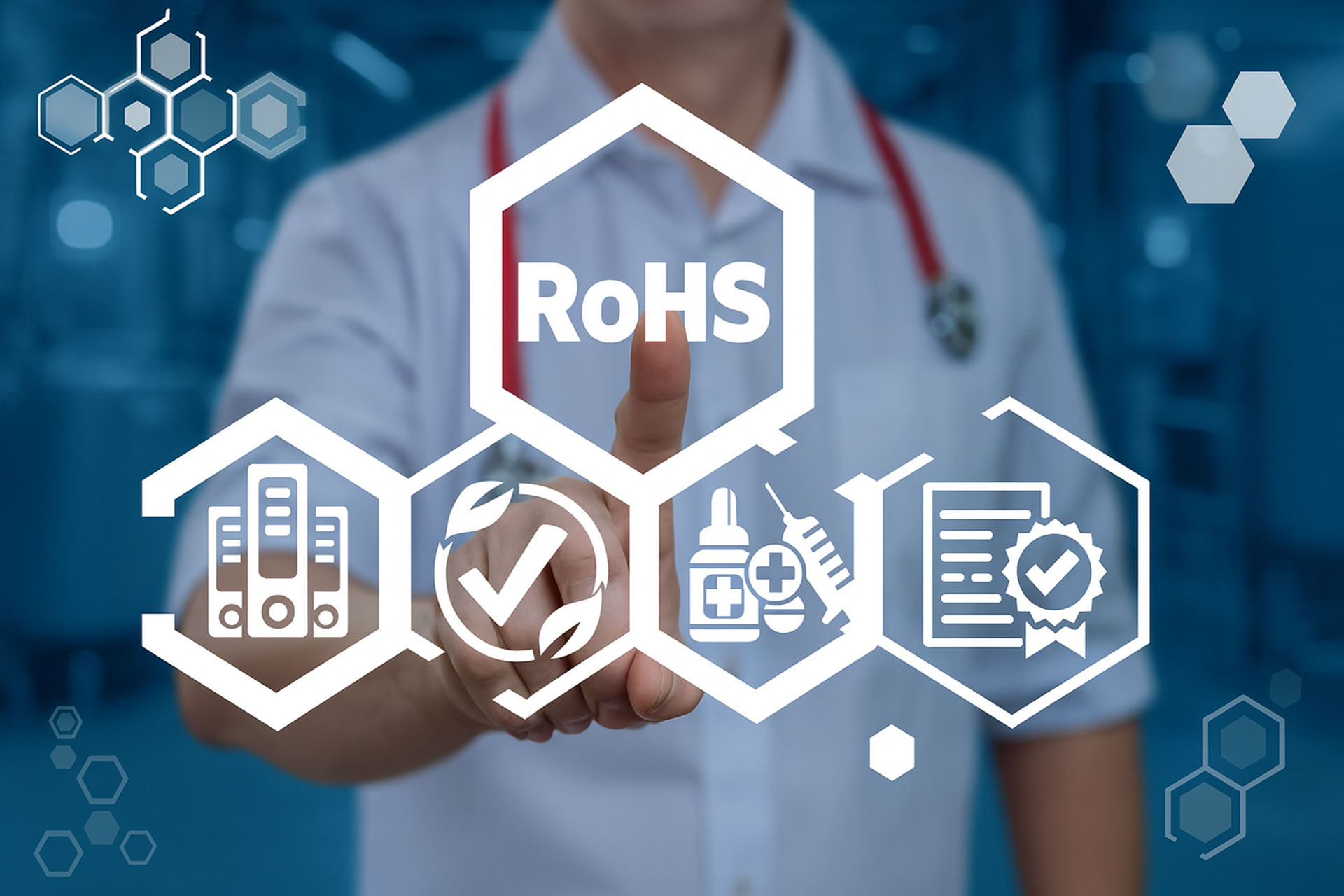
RoHS regulations: substances of very high concern for electrical products

Categories
01/09/2025
The RoHS (Restriction of Hazardous Substances) regulations are one of the European Union's key tools for promoting safer and more environmentally friendly industrial production. Today, ecological transition is a strategic priority, and the RoHS regulations help prevent the spread of toxic substances by promoting more responsible production solutions. For companies, this means not only complying with a regulatory obligation, but also taking advantage of a concrete opportunity to improve product quality and access regulated industrial sectors.
rohs-regulations-rgpballs

What is the RoHS regulation and what is its objective?

The RoHS directive is a European Union regulation that bans or restricts the use of hazardous substances in electrical and electronic equipment (EEE). Introduced with the 2002/95/CE and subsequently updated with RoHS 2 (2011/65/EU) and RoHS3 (2015/863/EU), its purpose is to reduce the environmental impact of electronic devices by preventing the use of harmful materials.

Restricted substances include lead, mercury, cadmium, hexavalent chromium, PBB, PBDE and certain phthalates, each with precise concentration limits.

In addition to a legal obligation, RoHS is also a lever to increase the quality, safety and reliability of products, while strengthening the position of companies in controlled markets such as Europe.

Substances banned by RoHS

The RoHS directive sets strict limits (0.1% by weight for homogeneous material, 0.01% for cadmium) for 10 hazardous substances commonly found in electronics:

  • Lead (Pb)

Historically used in solder and metal alloys, lead is highly toxic. It can accumulate in the body and cause severe neurological damage, especially in children. 

  • Mercury (Hg)

Used in fluorescent lamps and switches, mercury is dangerous to the central nervous system and tends to bioaccumulate in aquatic ecosystems.

  • Cadmium (Cd)

Found in batteries, pigments and coatings, cadmium is carcinogenic and can cause kidney and bone damage, even in very low concentrations.

  • Hexavalent chromium (Cr6+)

Used in anti-corrosion processes on metals, it is known for its toxicity and carcinogenic effects. It can also cause severe respiratory and skin irritation.

  • Polybrominated biphenyls (PBB) and polybrominated diphenyl ethers (PBDE)

These are flame retardants often found in plastics. They are persistent substances, difficult to degrade in the environment and potentially toxic to wildlife.

  • Phthalates (DEHP, BBP, DBP, DIBP)

Added in 2015 with RoHS 3, these plasticisers used to make plastics more flexible are classified as endocrine disruptors and can adversely affect fertility and the development of the reproductive system.

The scope of application of RoHS

The RoHS directive applies to a broad spectrum of electrical and electronic equipment, covering products intended for domestic use as well as those used in professional and industrial environments.

The scope has been progressively extended over time, now including a variety of categories encompassing most of the technological devices on the market.

Among the most important are:

  • large household appliances
  • small household appliances
  • IT and telecommunications equipment
  • consumer electronics
  • lighting systems
  • electrical tools
  • toys, sports and leisure articles and equipment
  • vending machines
  • medical and monitoring devices
  • monitoring and control instruments, including industrial ones 
  • other EEE not included in the above categories

Obligations and responsibilities for producers and importers

All economic operators, producers, importers and distributors of AEE, as well as suppliers of technical components intended for integration in electronic devices (such as precision spheres, load-bearing spheres or rollers) must ensure compliance with this legislation, through specific analyses and documentation certifying the absence of these substances beyond the permitted limits.

Being RoHS compliant is now an essential requirement for marketing in Europe.

Responsibilities include:

  • use of compliant materials
  • drafting and maintaining technical documentation
  • affixing CE marking
  • lot traceability
  • control of the supply chain

In the event of non-compliance, risks range from reputational damage to penalties and even withdrawal from the market.

Investing in compliance therefore means reducing risks, enhancing reputation and accessing markets bound by regulations with greater credibility.

RoHS and REACH: complementary regulations

RoHS often complements the REACH regulation  (EC 1907/2006), which regulates the use of chemicals in all sectors. But while RoHS restricts specific substances in EEE, REACH imposes registration, evaluation and reporting obligations for ALL substances, especially those classified as SVHC (Substances of Very High Concern).

For manufacturers of technical components, it is crucial to integrate RoHS and REACH requirements into a single compliance management strategy.

Therefore, in summary:

RoHS REACH
Scope Electrical and electronic products All chemical substances
Purposes Limitation of 10 prohibited substances Evaluation and restriction of substances
Obligation CE marking, technical documentation Registration, authorisation, communication

RGPBALLS commitment to regulatory and environmental compliance

RGPBALLS has always stood for a rigorous and proactive approach to sustainability, based on material safety and compliance with European regulations. Thanks to our in-house metallography laboratory, we carry out specific checks and in-depth analyses to ensure that every component meets the requirements of the RoHS directive and all other applicable regulations in our sectors.

Relying on RGPBALLS means choosing an experienced, transparent and up-to-date partner capable of offering compliant, reliable and sustainable solutions across the entire production chain.


Do you need support for RoHS compliance?
We can help you make your products easily and safely compliant
CONTACT US

Related articles
iso-9001-2015
08/10/2025 UNI EN ISO 9001:2015 Standard: efficiency and effectiveness of company performance
Production efficiency, consistent quality and the ability to promptly respond to customer needs: these are the pillars upon which a company's credibility is based on nowadays. In this context, the UNI EN ISO 9001:2015 standard represents the international reference for implementing a Quality Management System (QMS) that is solid, traceable and oriented towards the continuous improvement of company performance. In sectors, such as manufacturing, but likewise in all industrial and regulated sectors, where efficiency and effectiveness, precision and reliability do not permit compromise, ISO 9001:2015 certification is the foundation of our manufacturing identity: because it does not merely describe what we do, but demonstrates how we do it, confirming our commitment to quality, transparency and sustainable competitiveness.
reach-regulation-rgpballs
27/08/2025 The REACH regulation for particularly hazardous substances
The modern industry can no longer ignore the impact of chemicals on the environment and human health. In an increasingly stringent regulatory landscape, the REACH regulation emerges as an essential tool to ensure safety, traceability and accountability throughout the supply chain. For technical and industrial companies, understanding the REACH regulation and its implications is not only about avoiding penalties or marketing blockages, but is a strategic lever to build credibility, anticipate risks and enhance products in line with customer and stakeholder expectations.
bearing-ball-maintenance
25/07/2025 How to ensure the durability of bearing balls with proper maintenance
Ball bearings are essential components in many industrial operations, from heavy machinery to engines and precision devices. Proper maintenance of bearing balls is essential to preserve their performance, reduce wear and optimise operational efficiency, avoiding sudden failures and malfunctions.
machinery-vibration-analysis
21/07/2025 Precision balls and vibration analysis: how to reduce noise in industrial machinery
The analysis of vibrations in industrial machinery, thanks in part to precision balls, helps to reduce unwanted oscillations, contributing to quieter, more efficient and more reliable functioning. But how does this phenomenon occur?
precision-tolerances-rgpballs
17/07/2025 What are precision tolerances and why are they crucial in the production of industrial balls
In industrial engineering and manufacturing, precision is not an option but an essential requirement. When manufacturing components such as precision balls, rollers and carrier balls, even a variation of a few micrometres can make a difference. This is why precision tolerances play a crucial role in determining the quality and performance of these products.
italyx-il-sole-24-ore-rgpballs
11/07/2025 RGPBALLS obtains ItalyX certification from Il Sole 24
RGPBALLS has officially become one of Italian excellence 's after being recognised with ItalyX certification from Il Sole 24 ORE: an accomplishment that rewards our constant commitment to quality, innovation and the enhancement of the most authentic Italian values. This achievement does not only celebrate our journey, but also strengthens RGPBALLS' competitive positioning on national and international markets, confirming us to be ambassadors of a unique style, consisting of creativity, attention to detail and a continuous search for excellence.
industrial-predictive-maintenance
20/06/2025 Predictive industrial maintenance: how to improve machinery performance with precision balls
Predictive industrial maintenance is an innovative solution for optimising the efficiency of production facilities. Based on the advanced analysis of real-time data, this methodology makes it possible to predict breakdowns, reduce downtime and improve company productivity. Predictive maintenance does not replace the preventive model, but complements and enhances it, resulting in a more targeted approach that is less prone to emergency interventions. The integration of IoT sensors, machine learning and artificial intelligence helps companies proactively monitor the wear and tear of critical components, while improving safety and reducing operating costs. One of the key, but often overlooked, elements in ensuring the proper functioning of machinery are precision balls, which are key components used in bearings, mechanical joints, linear guides and other industrial systems.
specimens-analysis-test-reports-rgpballs
06/06/2025 Producing specimens, analysis and test reports for RGPBALLS precision balls
Precision balls are essential components in many industries which directly influence the performance and reliability of end products. To ensure maximum precision, a rigorous testing process including specimen production, structural analysis and the issuing of test reports is therefore essential. These steps make it possible to identify any non-conformities, monitor batch quality and evaluate the effectiveness of heat treatments.
intelligence-artificial-industry
30/05/2025 What role does Artificial Intelligence (AI) play in the industrial production of precision balls?
In the quest for efficiency and innovation, Artificial Intelligence is redefining production processes in the industry, improving efficiency and quality. One area where AI is making a difference is in the production of precision balls, which are essential components for bearings, valves and transmission systems: thanks to advanced machine learning algorithms and neural networks, it is now possible to optimise the material selection, reduce scrap and improve dimensional tolerances with a precision that was unthinkable just a few years ago. Artificial intelligence (AI)-based systems analyse huge amounts of data from advanced sensors in real time, quickly detecting defects and adjusting production parameters. Let's take a detailed look at the pros and cons.
laboratory-metallographic-rgpballs
23/05/2025 The RGPBALLS Metallographic Lab: innovation and precision in materials
At the core of our mission is a constant commitment: to ensure that every product that leaves our hands is synonymous with excellence. At the RGPBALLS Metallographic Laboratory, quality is not just a goal, but a promise that is realised through rigorous analysis and state-of-the-art technology. Using state-of-the-art instrumentation and a team of highly qualified specialists, our laboratory performs sophisticated microstructural checks to assess the strength, purity and suitability of materials, with a special focus on precision balls. Each test is designed to improve component durability and performance, supporting companies in optimising their production processes.
industrial-productive-efficiency
20/05/2025 How precision balls help reduce efficiency losses in industrial machinery
Industrial production efficiency in machinery is key to optimising productivity, cutting costs and remaining competitive. An often underestimated but crucial element in improving machinery performance is precision balls. These technologically advanced elements help reduce friction, wear and energy waste, thereby optimising the operation of various equipment.
metrology-lab-rgpballs
15/05/2025 The RGPBALLS Metrology Lab: guarantee of accuracy and reliability
In the production of precision balls, rollers and carrier balls, product accuracy and reliability are not an optional extra: every micron makes a difference. For this reason, a well-equipped metrology lab is essential to perform rigorous tests and accurate checks on the components produced. The use of incorrectly calibrated measuring instruments can generate rejects and increase production costs. Companies must therefore rely on certified laboratories that, through periodic checks and calibrations, can ensure accurate measurements that comply with standards.