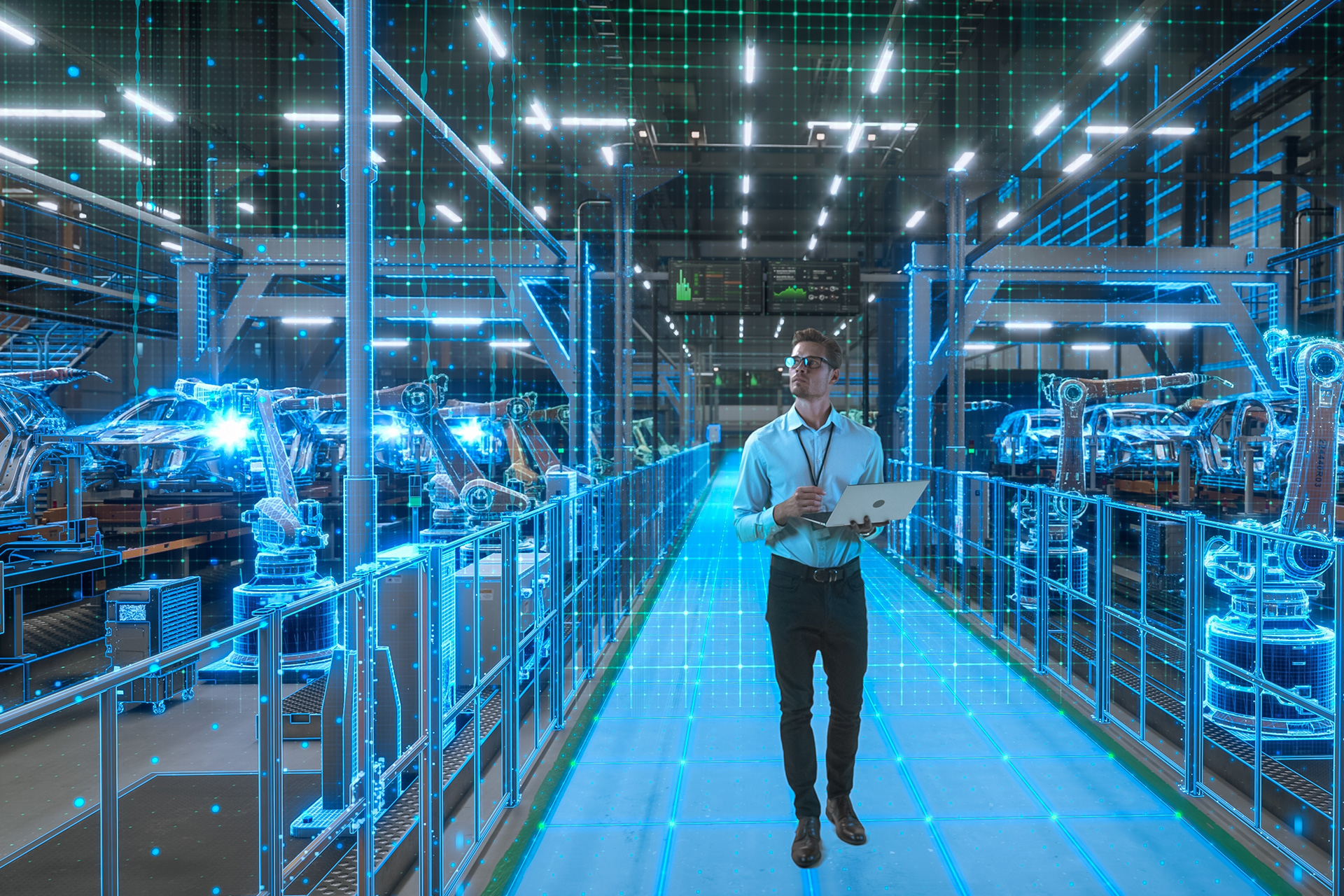
Collaborative robots, advanced CNC machines, intelligent sensors and artificial vision systems communicate in real time, ensuring operational continuity, traceability and quality control that minimises errors and defects.
However, the human role does not disappear. On the contrary, it evolves. Operators move from manual execution to supervision and data analysis, contributing to continuous quality improvement.
From the workshop to the smart factory: the evolution of industrial automation
The path of industrial automation has revolutionised ball production:
- Programmable automation: with the introduction of PLCs and CNC machines in the 1970s, production lines achieved micrometric tolerances and a flexibility that was previously unthinkable.
- Industry 4.0: today, IoT, big data and Artificial Intelligence have made processes adaptive and predictive, preventing failures and optimising consumption in real time.
- Digital Twin: virtual replication of production lines allows simulations and tests to be carried out before any real changes are made, reducing experimentation times and costs.
Collaborative and adaptive robotics now play a central role, combining safety, precision and flexibility. For example, cobots can work side by side with operators, detecting accidental contact and adapting to variable tasks; 3D artificial vision systems also enable complex scenarios to be managed, such as picking up balls arranged in a disorderly manner.
Practical applications of automation in ball production
Automation now plays a key role in every stage of the precision ball production cycle, from cutting the metal wire to packaging the finished product. Anthropomorphic robots, automated lapping and polishing machines and optical sensors work in synergy with centralised control software.
Assembling, polishing, quality control
Automation translates into total control of all crucial stages:
- During the forging and assembling phases, high-precision robots perform repetitive operations with movements calibrated to the micron, reducing waste and differences between batches.
- During polishing, automated robots apply controlled pressure, achieving perfectly uniform surfaces free of micro-imperfections: a fundamental aspect in ensuring the durability and performance of balls in critical applications.
- Finally, there is quality control, which is now fully automated. Laser sensors and optical systems analyse diameter, roundness and roughness in real time, comparing each ball with digital reference models. This approach does not only speed up production, but also ensures that each component meets the most stringent specifications, with no margin for human error.
Integration with artificial vision systems for total control
Integration with artificial vision represents one of the most significant developments. High-resolution cameras inspect each ball from multiple angles, while machine vision algorithms detect scratches, irregularities or defects invisible to the human eye. In the event of an anomaly, the system automatically flags or corrects the process without interrupting the production cycle.
This synergy between automation, robotics and intelligent vision has made ball production not only faster, but also more reliable and predictable, reducing the need for manual checks and ensuring consistent quality, piece after piece.
The concrete advantages of automation in ball production
Automation brings measurable benefits in terms of quality, productivity, safety and sustainability:
- Consistent quality: elimination of variability linked to human intervention, with specifications and uniformity respected in every batch.
- Increased productivity: reduced cycle times, quick format changes, even on small series or prototypes.
- Workplace safety: operators employed for supervisory activities rather than repetitive or risky tasks.
- Sustainability and savings: intelligent systems optimise energy consumption and reduce material waste.
Automation and digitalisation: a strategic combination
The full efficiency of automation can only be achieved through data integration. IoT sensors, cloud platforms and interconnected management systems are transforming production lines into smart ecosystems, capable of autonomously correcting and optimising every stage of production.
The automation of ball production thus becomes a strategic component of the smart factory, where machines, software and people work together to ensure efficiency, traceability and operational continuity.
To find out how automation integrates seamlessly with intelligent data management, read our in-depth article on the digitalisation of industrial processes.
RGPBALLS puts innovation and control into every detail
At RGPBALLS, ball production automation and digitalisation govern every stage, from raw material to finished product. Advanced robotics, artificial vision and digital control systems do not replace human skills, but enhance them: they minimise the risks of non-compliance and guarantee reliable processes.
The result is a range of certified balls that are safe and comply with the most stringent standards, ensuring consistent quality and a lasting competitive advantage.
Do you want to increase the efficiency and reliability of your production processes?
Discover how automation can become your competitive advantage.











20092 Cinisello Balsamo (MI) - Italy
P.I. / C.F. / Reg. Impr. 08678490965
N. REA: MI-2042305
Cap. soc. € 1.000.000 int. vers.

Please note that any particular and specific technical requirements must always be requested in advance during the quotation phase.