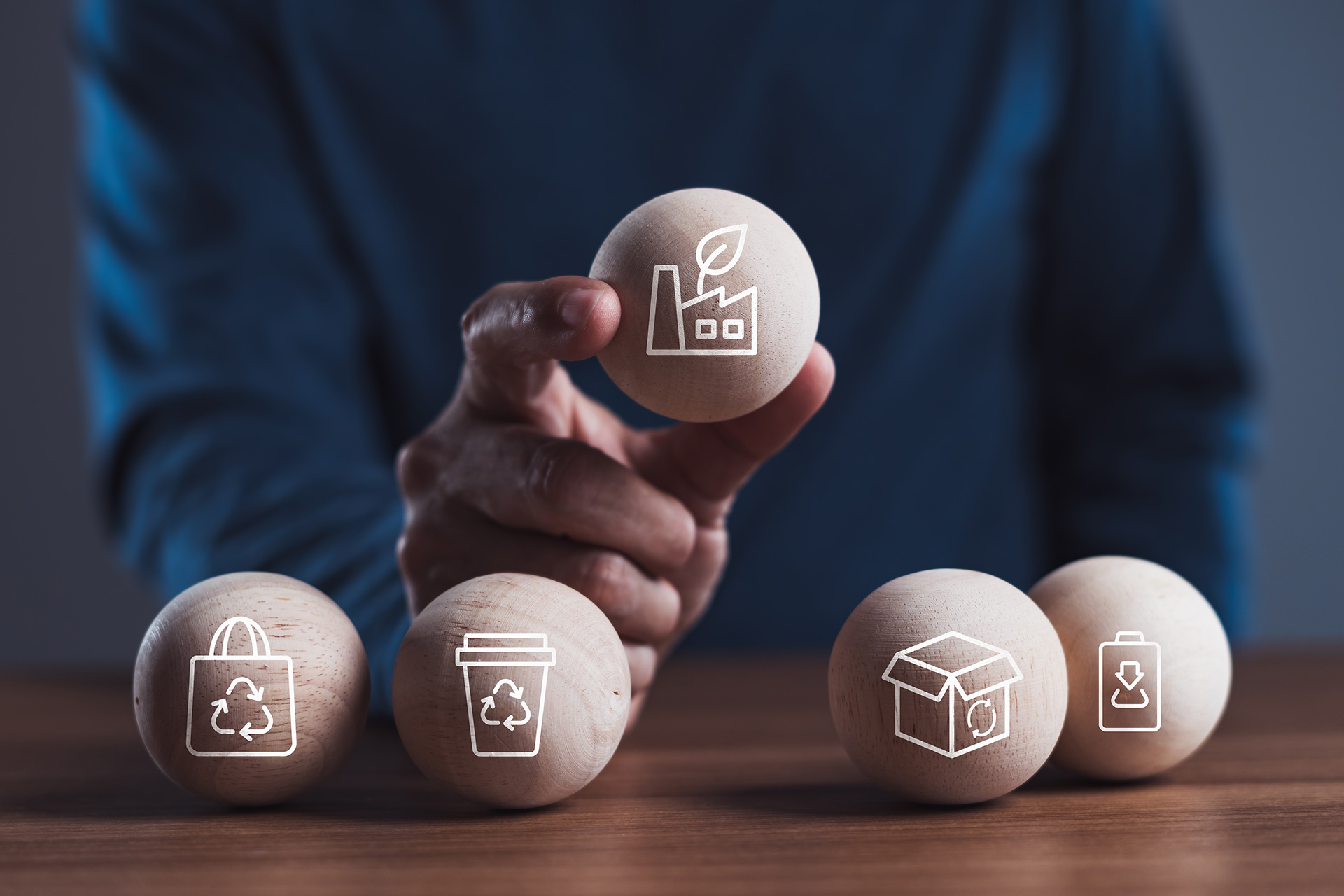
This approach has evolved from a trend to an indispensable competitive requirement. Supply chains and customers demand transparency on the carbon footprint of individual components, while the regulatory framework is becoming increasingly stringent. In this context, green materials are a necessary response and, above all, a strategic opportunity to ensure competitiveness and long-term business continuity.
Why focusing on industrial green materials really pays off
Adopting materials with a low environmental impact means first and foremost
- reduce operating costs
- optimising resources
- meeting the demands of customers and partners who are increasingly sensitive to the issue of sustainability
To fully understand the value of this choice, it may be useful to compare the impact of conventional materials with the advantages of ecological alternatives.
The environmental burden of conventional industrial materials
Steels and alloys commonly used in ball production provide high strength and precision, but require energy-intensive and complex processes. Although recyclable, their environmental footprint varies greatly depending on the origin of the raw materials and the processing technologies used.
The concrete benefits of industrial green materials
Industrial green materials were created to reduce energy consumption, emissions and waste while improving recyclability. The use of renewable resources or secondary raw materials makes it possible to alleviate dependence on virgin resources and anticipate future regulatory obligations. In addition, they offer indirect benefits such as increased efficiency, access to premium markets and regulatory compliance.
The main types of environmentally friendly materials for the ball industry
The solutions available today range from light, medium and critical use without compromising performance. They span from recycled and bio-based polymers to recyclable metal alloys and ceramics, each with specific peculiarities that, when exploited, make it possible to combine technical efficiency with reduced environmental impact.
Bioplastics and recycled polymers, versatile and sustainable
Polymers are a versatile solution particularly in moderate-load applications. Bio-based versions reduce the consumption of fossil resources while maintaining light weight, chemical resistance and ease of processing.
Materials such as polyethylene UHMWPE, polypropylene (PP), elastomeric polyester (Hytrel TPEE) or POM are also available in recycled variants and are used in the production of balls for non-critical purposes, where wear, weight and chemical resistance are more important than absolute rigidity. Some examples: linear guides, handling systems, pumps and valves, but also sectors such as food, medical, chemical and automation.
Low-impact metal alloys: high performance with fewer emissions
Metal alloys remain essential for high-performance operations, but some are considered low-impact due to their extremely efficient recycling cycles.
- Carbon steel: among the most recycled materials in the world, when produced from scrap in an electric furnace, it significantly reduces the CO₂ footprint.
- Aluminium: light, strong and highly recyclable; its remelting requires up to 95% less energy than primary aluminium
- Copper-brass-bronze alloys: widely reusable and popular especially in mechanical and fluid-dynamic fields.
Performance and sustainability in industrial green materials: how to find the right balance
A recurring question is: ‘Do green materials guarantee the same performance as traditional ones?’
In reality, the answer always depends on the specific use.
- In areas such as handling, packaging or certain industrial valves, recycled polymers and technical ceramics are already proving to be extremely cost-effective and often superior in terms of chemical resistance and lightness.
- In areas requiring superior mechanical properties or resistance to extreme conditions, however, traditional alloys remain preferable to ensure safety and longevity.
The most effective solution is to evaluate on a case-by-case basis: adopt environmentally friendly materials where they provide the right performance and reserve high-impact materials only when indispensable. And this is exactly the approach that RGPBALLS advocates, accompanying customers in a gradual and balanced transition between performance, sustainability and cost.
The future of ecological industrial materials between research and innovation
Today, research into materials for industrial balls is moving towards increasingly high-performance and sustainable solutions.
Among the most promising trends are:
- Advanced biocomposites, which combine bio-based polymers with natural fibres or mineral reinforcements to increase stiffness and strength without sacrificing lightness.
- Hybrid ceramics and eco-friendly coatings that limit wear and the need for lubricants and frequent replacements
- Low-emission production processes such as 3D printing or reduced-energy sintering.
- Circular economy chains dedicated to recovering and reusing polymers, glass and alloys, and re-introducing materials into the production cycle without loss of quality.
All these developments apply eco-design principles from the earliest design stages, with the aim of creating durable components with minimal impact.
RGPBALLS’ commitment: industrial green materials at the heart of the strategy
RGPBALLS closely follows these innovations to offer its customers both established materials and emerging solutions, integrated into a diversified portfolio.
The evaluation of industrial ecological materials is an integral part of the service, along with technical advice, thorough internal audits and support in selecting the most suitable solutions for each specific use.
This is just one of the key aspects of the ecological transition. For a complete overview, we would like to refer you to our in-depth article on sustainability in the industry.
Find out how we can support your sustainability goals with precision components made of environmentally friendly materials.










20092 Cinisello Balsamo (MI) - Italy
P.I. / C.F. / Reg. Impr. 08678490965
N. REA: MI-2042305
Cap. soc. € 1.000.000 int. vers.

Please note that any particular and specific technical requirements must always be requested in advance during the quotation phase.